

Key Reasons Poor Revenue Cycle Management Leads to Claim Denials
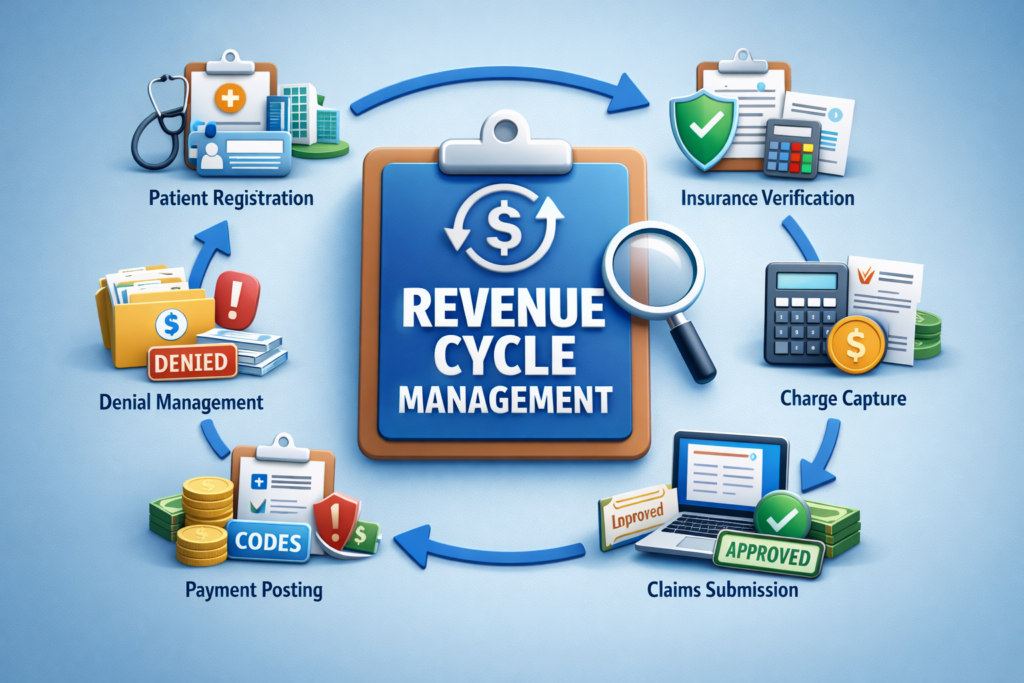
In the complex landscape of healthcare, Revenue Cycle Management (RCM) is the backbone of financial stability for any practice. From patient registration to claim submission, coding, and payment posting, every step must be carefully managed. When revenue cycle processes are inefficient or poorly executed, it directly leads to claim denials, delayed reimbursements, and unnecessary financial loss.
Healthcare providers, especially small and mid-sized practices, often underestimate the cost of improper RCM. Claim denials are not just administrative inconveniences—they represent lost revenue, wasted staff hours, and disruption to cash flow. Understanding the link between poor RCM and claim denials is essential for practices striving for financial efficiency and stability.
The Connection Between Poor RCM and Claim Denials
Revenue cycle management is more than billing—it is a comprehensive approach to handling all financial transactions for patient services. Poor RCM often manifests as:
- Incomplete or incorrect patient data
- Missed insurance verifications
- Coding errors or outdated code usage
- Delayed claim submissions
- Failure to obtain prior authorizations or referrals
Each of these issues increases the likelihood of denied claims, which may take weeks or months to resolve. Even minor errors, like an incorrect ICD-10 digit or missing patient information, can prevent a claim from being paid.
Ultimately, poor RCM creates a domino effect: errors at the front-end lead to denials, denials slow cash flow, and delayed payments reduce operational efficiency and profitability.
Common Causes of Claim Denials
Understanding why claims are denied is the first step toward effective RCM. Some of the most frequent causes include:
- Patient Eligibility and Coverage Issues
Claims are denied if the patient’s insurance is inactive, coverage has lapsed, or the service is not covered. - Coding Errors
Incorrect ICD-10, CPT, or HCPCS codes, unbundling, or improper modifier use are major reasons for denials. - Missing or Incomplete Documentation
Payers may reject claims when essential clinical documentation, prior authorizations, or referral information is missing. - Late Submissions
Claims submitted past payer deadlines are automatically denied, often without recourse. - Lack of Medical Necessity
Services must be supported by detailed clinical notes. Inadequate documentation can result in denial for “lack of medical necessity.”
When practices attempt to manage these issues manually or rely on disjointed systems, errors multiply, increasing both the volume and complexity of denied claims.
How Efficient Revenue Cycle Management Reduces Claim Denials
A well-designed RCM process significantly lowers the risk of claim denials. Here’s how:
Front-End Verification and Real-Time Eligibility Checks
Verifying insurance coverage and patient eligibility at the time of scheduling and check-in prevents many denials before they occur. Real-time verification ensures services are covered, co-pays are collected, and prior authorizations are in place.
Accurate Coding and Documentation
Professional coders apply the latest CPT, ICD-10, and HCPCS codes, with specialty-specific knowledge to prevent coding-related denials. Proper documentation ensures all services are justified and auditable.
Timely and Correct Claim Submission
Automated RCM systems submit claims according to payer-specific rules, improving first-pass acceptance rates and reducing delays.
Denial Management and Appeals
When a denial occurs, effective RCM identifies root causes, implements corrective actions, and tracks trends to prevent recurrence. This approach turns denials from revenue blockers into opportunities for process improvement.
Analytics-Driven Decision Making
Data analytics in RCM identifies denial patterns, predicts potential problem claims, and provides actionable insights to reduce errors. Practices using analytics can proactively address issues before claims are rejected.
Automation in RCM
Automation tools like claim scrubbing, robotic process automation, and integrated eligibility verification reduce human error, speed up claim processing, and enhance accuracy. Automation ensures repetitive, high-risk tasks are done right the first time, minimizing denials.
Step-by-Step Approach to Reducing Claim Denials
- Identify and Classify Denials – Track denial codes provided by payers to understand patterns.
- Root Cause Analysis – Determine whether denials arise from registration, coding, documentation, or prior authorizations.
- Corrective Actions – Implement process improvements such as automated eligibility checks and claim scrubbing.
- Staff Training – Train your team on coding updates, payer rules, and documentation standards to prevent errors.
- Monitor and Analyze – Use RCM analytics to assess denial trends and measure effectiveness of interventions.
When these steps are implemented consistently, denial rates can drop to 5% or less, and some high-performing practices achieve rates as low as 1–2%.
Benefits of Strong Revenue Cycle Management
Efficient RCM does more than reduce denials—it transforms the financial health of a practice:
- Faster Cash Flow – Claims are paid quicker, improving liquidity.
- Reduced Administrative Burden – Automated and streamlined workflows free staff to focus on patient care.
- Increased Revenue – Fewer denials and accurate coding ensure full reimbursement.
- Regulatory Compliance – Staying up to date with HIPAA, payer, and coding regulations minimizes audit risk.
Operational Insights – Advanced analytics provide actionable data to optimize the medical billing revenue cycle continuously.
Why MDBC Pro Is Your Partner for RCM Excellence
At MDBC Pro, we combine expertise, technology, and specialized workflows to help practices reduce claim denials and improve revenue. Our approach includes:
- Certified Medical Coding & Billing Experts – Skilled coders for ICD-10, CPT, HCPCS, and E/M services.
- Real-Time Eligibility Verification – Proactive coverage checks to prevent front-end denials.
- Denial Prevention Workflows – Automated claim scrubbing, root cause analysis, and corrective actions.
- Analytics-Driven Insights – Track denials, monitor trends, and implement improvements.
- Scalable Solutions – Services tailored for solo practices, multi-specialty clinics, and hospitals nationwide.
By outsourcing RCM to MDBC Pro, healthcare providers can focus on patient care while ensuring claims are accurate, compliant, and processed efficiently.
Conclusion
Poor revenue cycle management is a silent threat to healthcare providers, directly increasing claim denials, delaying payments, and reducing profitability. Effective RCM—supported by automation, analytics, staff training, and proactive workflows—prevents denials, accelerates cash flow, and strengthens financial performance.
Investing in professional RCM and denial management is not just a back-office improvement; it’s a strategic move to protect revenue, reduce administrative stress, and secure your practice’s financial future. With MDBC Pro as a trusted partner, your billing and coding processes become a denial-resistant, revenue-maximizing engine—allowing you to concentrate on what truly matters: delivering high-quality patient care.

Author